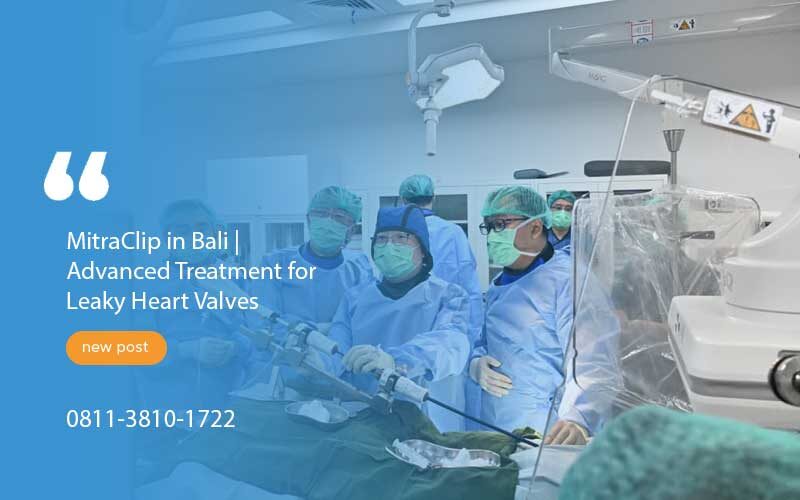
TEER Treatment in Bali | Mitral Valve Regurgitation Care
This article explains what TEER treatment in Bali involves, who may benefit, and how the evaluation process works at SCVC Bali.
Persistent Shortness of Breath? It May Be More Than Just Age
Shortness of breath can gradually become part of daily life.
Walking a few hundred meters may feel exhausting. Climbing stairs may leave you breathless. Some people may also experience repeated hospital admissions because of heart failure.
These symptoms are sometimes considered a normal part of aging. However, they can also be linked to mitral valve regurgitation, a condition in which the mitral valve does not close properly.
When the valve leaks, some blood flows backward into the left atrium each time the heart contracts. The heart may then need to work harder to maintain adequate blood flow to the body.
Over time, significant mitral regurgitation can contribute to heart enlargement, worsening
For many years, surgery has been an important treatment option for severe mitral valve disease. Today, selected patients may also be considered for a less invasive catheter-based procedure called Transcatheter Edge-to-Edge Repair (TEER).
For eligible patients, TEER treatment in Bali may provide another treatment option after comprehensive evaluation by a specialized Heart Team.
At SCVC Bali (Sapporo Cardio Vascular Clinic at Bali International Hospital), structural heart conditions can be evaluated through a multidisciplinary Heart Team approach. Advanced cardiac imaging and specialist collaboration are important parts of determining whether a transcatheter procedure is appropriate for an individual patient.
What Is Mitral Valve Regurgitation?
The heart has four valves that help blood move in the right direction.
The mitral valve is located between the left atrium and the left ventricle. It opens to allow blood to move into the left ventricle. It then closes when the heart contracts.
Normally, the valve should close tightly.
With mitral valve regurgitation, the valve does not close completely. Some blood flows backward into the left atrium instead of moving forward into the aorta.
A simple way to understand this is to imagine a water container with a small leak.
You need to add more water to maintain the same level. The heart faces a similar challenge when blood repeatedly flows backward.
If significant regurgitation continues for a long time, the heart may become enlarged and its pumping function may deteriorate.
The condition can also contribute to symptoms of heart failure.
What Causes Mitral Valve Regurgitation?
Mitral valve regurgitation can have different causes.
In some patients, the valve itself is abnormal or damaged. In others, the valve becomes leaky because the heart chambers have changed in size or shape.
Common causes include:
- Degenerative changes of the mitral valve.
- Mitral valve prolapse.
- Damage to the heart muscle after a heart attack.
- Heart failure with enlargement of the left ventricle.
- Congenital abnormalities of the valve.
- Rheumatic heart valve disease.
The cause of the regurgitation matters.
It can affect the severity of the condition, the anatomy of the valve, and the treatment options that may be considered.
That is why a detailed cardiac evaluation is important before deciding on treatment.
Symptoms of Mitral Valve Regurgitation You Should Not Ignore
Mild mitral regurgitation may cause no obvious symptoms.
Some people only discover the condition during a routine heart examination.
As the regurgitation becomes more significant, symptoms may become easier to notice.
Possible symptoms include:
- Shortness of breath during activity.
- Fatigue during everyday activities.
- Reduced exercise tolerance.
- Palpitations or an irregular heartbeat.
- Chest discomfort.
- Swelling in the legs or ankles.
- Shortness of breath when lying down.
- Repeated hospital admissions related to heart failure.
These symptoms do not automatically mean that you have mitral valve regurgitation.
Several heart and lung conditions can cause similar complaints.
A cardiology evaluation is therefore important to identify the underlying cause.
Does Every Leaky Mitral Valve Require Surgery?
No.
Not every patient with mitral valve regurgitation needs an intervention.
The appropriate approach depends on the severity of the regurgitation, symptoms, heart function, valve anatomy, underlying cause, and overall health.
Some patients may be managed with medication and regular monitoring.
Other patients with severe or clinically significant regurgitation may need a procedure to repair the valve.
Depending on the individual case, treatment options may include:
- Medical therapy.
- Surgical mitral valve repair.
- Surgical mitral valve replacement.
- Transcatheter Edge-to-Edge Repair (TEER) using a clip device.
The decision should be made after a comprehensive assessment.
The Heart Team considers factors such as valve anatomy, the type and severity of mitral regurgitation, heart function, age, other medical conditions, and surgical risk.
Current European guidelines also emphasize the role of experienced Heart Teams, advanced imaging, and appropriate heart valve centres when complex valve interventions are being considered.
What Is a TEER Clip?

A Clip is a catheter-based device used for Transcatheter Edge-to-Edge Repair (TEER) of the mitral valve. This minimally invasive approach is part of the treatment options evaluated for selected patients seeking TEER treatment in Bali.
Unlike conventional open-heart surgery, TEER does not require a large opening of the chest.
The Clip is delivered through a catheter, usually through a vein in the groin, and guided toward the heart.
Once positioned, the Clip grasps the mitral valve leaflets.
This brings the leaflets closer together and helps reduce the amount of blood flowing backward through the valve.
The procedure is performed using advanced imaging to help the medical team position the Clip accurately.
The exact approach and suitability depend on the patient’s anatomy and clinical condition.
TEER vs. Open-Heart Mitral Valve Surgery
TEER and surgical mitral valve treatment are different approaches.
The right option depends on the patient’s individual condition.
TEER
TEER is performed through a catheter rather than through a large chest incision.
This makes it a minimally invasive approach.
It may be considered for selected patients when surgery carries a high or prohibitive risk, or when the clinical situation and valve anatomy make TEER appropriate.
Surgical Mitral Valve Repair
Surgery can provide direct access to the mitral valve.
For patients who are suitable surgical candidates, surgical repair can remain an important treatment option, particularly for certain forms of severe primary mitral regurgitation.
Surgical Mitral Valve Replacement
When repair is not appropriate or feasible, valve replacement may be considered.
The choice between repair, replacement, and TEER requires detailed assessment by the treating team.
There is no single procedure that is appropriate for every patient.
Who May Be Considered for TEER?
TEER is not automatically suitable for everyone with mitral valve regurgitation.
Patient selection is one of the most important parts of the treatment process.
The Heart Team may evaluate:
- The severity of mitral regurgitation.
- Whether the regurgitation is primary or secondary.
- The anatomy and structure of the mitral valve.
- Left ventricular function.
- Symptoms and functional limitations.
- Previous heart procedures.
- Other medical conditions.
- Surgical and procedural risk.
- The expected benefit of reducing mitral regurgitation.
Advanced echocardiography is particularly important.
Transesophageal echocardiography can help assess the valve anatomy, determine whether TEER is technically feasible, guide the procedure, and evaluate the result.
This careful assessment helps the Heart Team select the most appropriate treatment strategy for each patient.
What Happens During a TEER Procedure?
Understanding the steps involved in TEER treatment in Bali can help patients know what to expect. The procedure is performed in a specialized cardiac catheterization or structural heart setting.”
A simplified overview includes:
-
Patient Evaluation
The medical team reviews the patient’s symptoms, medical history, imaging, and previous treatments.
-
Advanced Cardiac Imaging
Echocardiography is used to assess the mitral valve and determine whether the anatomy is suitable for TEER.
-
Catheter Access
This device is inserted through a catheter that is inserted into a blood vessel, usually through the groin.
-
Navigation to the Heart
Next, the catheter is carefully guided toward the mitral valve using imaging.
-
Clip Placement
The clip device is positioned to grasp the mitral valve leaflets.
-
Assessment of the Result
The Heart Team evaluates the reduction in mitral regurgitation and checks the valve function.
-
Recovery and Follow-Up
After the procedure, the patient is monitored and receives follow-up care based on the individual clinical situation.
The exact procedure and recovery period can vary from one patient to another.
What Are the Potential Benefits of TEER?
For appropriately selected patients, TEER can offer several potential benefits.
These may include:
- Reduced mitral valve regurgitation.
- Improvement in symptoms such as shortness of breath.
- Better ability to perform daily activities.
- Improved quality of life.
- A less invasive alternative for selected patients who are at high surgical risk.
However, the expected benefits vary between patients.
TEER is not a guarantee of symptom relief or freedom from future heart problems.
The procedure also has potential risks and complications, which should be discussed with the treating Heart Team before treatment.
TEER Treatment in Bali | Evaluation at SCVC Bali
For patients looking for TEER treatment in Bali, understanding the treatment pathway is an important first step.
SCVC Bali provides evaluation for patients who may be candidates for TEER based on their mitral valve condition, symptoms, heart function, valve anatomy, and overall procedural risk.
At SCVC Bali (Sapporo Cardio Vascular Clinic at Bali International Hospital), patients with structural heart conditions can undergo evaluation by a multidisciplinary cardiac team.
This evaluation may include a clinical assessment and advanced cardiac imaging.
The purpose is to understand the patient’s condition in detail.
The Heart Team can then determine whether TEER or another treatment approach may be appropriate.
Treatment decisions should always be individualized.
Not every patient with mitral valve regurgitation is a candidate for TEER.
See also: MitraClip in Bali
Take the Next Step for Your Heart
Persistent breathlessness should not always be dismissed as a normal part of aging.
Mitral valve regurgitation can place additional strain on the heart when it becomes significant.
Today, selected patients may have access to minimally invasive treatment options such as TEER.
The most suitable treatment depends on the patient’s valve anatomy, heart function, symptoms, overall health, and procedural risk.
If you are looking for TEER in Bali, a comprehensive evaluation by an experienced Heart Team can help determine the next appropriate step.
Contact SCVC Bali to discuss your heart condition and explore the available treatment options with our cardiac specialists.
Our Contact: (SCVC): 0811-3810-1722