Coronary Stent Placement in Bali | Modern PCI & Faster Recovery
Coronary Stent Placement in Bali is a minimally invasive treatment option for patients with narrowed or blocked coronary arteries. With modern interventional cardiology technologies and individualized care, PCI can help restore blood flow and support better treatment outcomes for appropriately selected patients.
When Your Doctor Recommends a Coronary Stent: What Should You Know?
Being told that you may need a coronary stent can be an overwhelming experience. Patients and their families often have many questions immediately after receiving the recommendation.
Do I need open-heart surgery?
Is the procedure dangerous?
How long will I need to stay in the hospital?
Can my artery become blocked again after a stent is placed?
These concerns are completely understandable.
Fortunately, advances in interventional cardiology have significantly changed the way coronary artery disease is treated.
Today, Percutaneous Coronary Intervention (PCI), commonly known as coronary angioplasty and stent placement, is a minimally invasive procedure commonly used in Coronary Stent Placement in Bali for appropriately selected patients.
However, successful PCI is not simply about opening a blocked artery or placing a stent.
Long-term outcomes also depend on appropriate patient selection, lesion preparation, stent selection, accurate assessment of the coronary artery, and optimization of the final result. Modern interventional cardiology therefore combines operator expertise with advanced imaging and lesion-specific technologies.
At SCVC Bali (Sapporo Cardio Vascular Clinic at Bali International Hospital), PCI is approached as an individualized treatment. Depending on the patient’s condition, the interventional team may utilize technologies such as latest-generation Drug-Eluting Stents (DES), Intravascular Ultrasound (IVUS), calcium-modification technologies, and a Fast Track PCI pathway for eligible patients.
This article explains what coronary stent placement is, when PCI may be recommended, how the procedure is performed, what technologies can be used during complex coronary interventions, and why a comprehensive treatment strategy matters for long-term cardiovascular health.
What Is Coronary Stent Placement (PCI)?
Percutaneous Coronary Intervention (PCI) is a minimally invasive procedure used to improve blood flow through coronary arteries that have become narrowed or blocked.
The coronary arteries supply oxygen-rich blood to the heart muscle. Coronary artery disease develops when plaque builds up inside these arteries. Plaque may contain cholesterol, fatty deposits, calcium, and other substances.
As the narrowing becomes more significant, blood flow to the heart muscle may become restricted. This can cause symptoms such as:
- Chest pain or pressure, commonly known as angina
- Shortness of breath, particularly during physical activity
- Unusual fatigue
- Pain that may radiate to the arm, shoulder, jaw, back, or other areas
- Acute myocardial infarction, or heart attack, when a coronary artery becomes suddenly and severely blocked
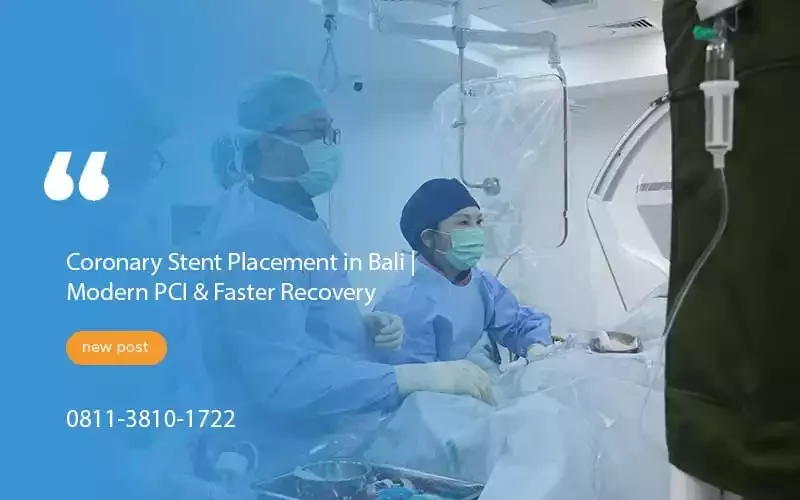
During PCI, a thin catheter is introduced through a blood vessel, commonly through the wrist using radial access or through the groin using femoral access.
The catheter is guided toward the coronary artery under X-ray imaging. A small balloon may then be inflated at the narrowed area to improve the opening.
When appropriate, a coronary stent is placed to help maintain the artery’s lumen after the narrowing has been treated.
Unlike open-heart surgery, PCI does not require opening the chest. This minimally invasive approach can allow appropriately selected patients to recover more quickly than they would after surgical revascularization.
However, PCI is not automatically the best treatment for every patient with coronary artery disease. The most appropriate treatment depends on the patient’s symptoms, anatomy, disease complexity, overall health, and clinical circumstances.
Have questions about coronary stent placement in Bali?
Contact the SCVC Bali team via WhatsApp at 0811-3810-1722 for further information.
When Is Coronary Stent Placement Needed?
Not every patient with coronary artery disease requires a stent.
The decision to perform PCI should be based on a comprehensive assessment by a qualified cardiology team. Depending on the clinical situation, treatment options may include medication, PCI, or coronary artery bypass grafting (CABG).
Coronary stent placement may be considered in situations such as the following.
Significant Coronary Artery Narrowing
Coronary imaging or angiography may identify a significant narrowing that affects blood flow to the heart muscle.
Depending on the patient’s symptoms and clinical findings, additional functional or anatomical assessment may be required before deciding whether revascularization is appropriate.
Persistent Angina Symptoms
Patients experiencing recurrent chest discomfort or angina related to coronary artery disease may be evaluated for revascularization when symptoms remain significant despite appropriate medical treatment.
Acute Heart Attack
In selected patients with an acute coronary syndrome, urgent PCI may be used to restore blood flow to the affected coronary artery.
The timing and type of intervention depend on the specific clinical presentation and the findings of the treating medical team.
High-Risk Findings on Cardiovascular Testing
Tests such as stress testing, stress echocardiography, myocardial perfusion imaging, CT coronary angiography, and invasive coronary angiography may provide important information when evaluating a patient with suspected or established coronary artery disease.
Importantly, the severity of narrowing alone does not always determine the best treatment.
Doctors may also consider:
- The number of affected coronary arteries
- The location of the lesions
- Plaque characteristics
- Coronary artery anatomy
- Heart function
- Other medical conditions
- Symptoms and clinical presentation
- The overall risk and expected benefit of revascularization
For complex cases, a Heart Team approach can help integrate different medical perspectives before a treatment decision is made.
If you have been advised to undergo PCI or coronary stent placement, contact SCVC Bali via WhatsApp at 0811-3810-1722 to discuss your next steps.
How Is Coronary Stent Placement Performed?
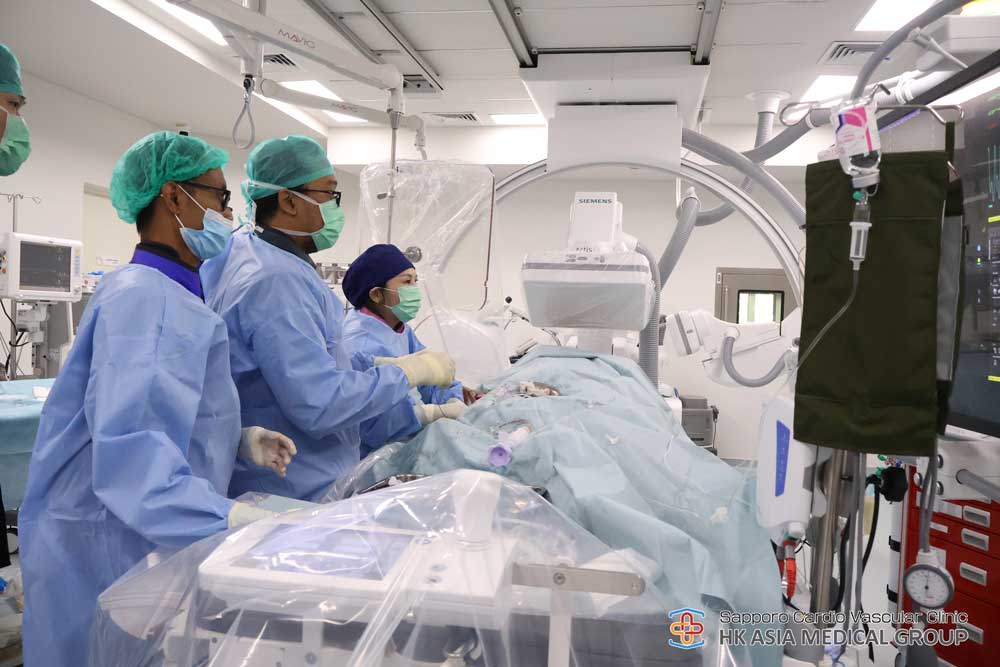
Many patients initially imagine coronary stent placement as major surgery. In reality, PCI is performed through a catheter and does not require opening the breastbone.
The exact procedure varies according to the patient’s anatomy and the complexity of the coronary lesion, but the process generally includes several stages.
Pre-Procedure Evaluation
Before PCI, the medical team reviews the patient’s medical history, symptoms, medications, allergies, previous cardiovascular procedures, and relevant risk factors.
Additional examinations may include:
- Physical examination
- Electrocardiogram (ECG)
- Blood tests
- Echocardiography
- CT coronary angiography when indicated
- Coronary angiography
- Other cardiovascular imaging or functional tests
This information helps the interventional cardiologist determine the most appropriate treatment strategy.
Vascular Access
A catheter is introduced through a blood vessel, commonly through the wrist or groin.
Radial access is frequently used when clinically appropriate and can be associated with advantages in patient comfort and recovery in suitable cases.
Local anesthesia is generally used at the access site, allowing the patient to remain awake during much of the procedure.
Opening the Narrowed Artery
The catheter is guided to the coronary artery containing the target lesion.
A guidewire is passed through the narrowed segment, followed by appropriate balloon-based or other lesion-preparation techniques depending on the characteristics of the blockage.
Stent Placement When Necessary
If a stent is indicated, the selected stent is positioned at the treated area and expanded to support the artery.
The choice of stent and implantation strategy depends on the patient’s coronary anatomy, lesion characteristics, and clinical condition.
Modern PCI increasingly emphasizes not only successful stent delivery but also appropriate lesion preparation and optimization of stent expansion and apposition.
Final Assessment
After treatment, the interventional team evaluates the final coronary result and blood flow.
In complex PCI, intravascular imaging such as IVUS may provide additional information about the vessel and the implanted stent.
After the procedure, the patient is monitored based on their condition and the complexity of the intervention.
The duration of PCI varies considerably. Straightforward procedures may be relatively short, while complex coronary interventions can take substantially longer.
Why Can PCI Outcomes Differ Between Hospitals?
Although two procedures may both be described as PCI, the complexity of the cases and the strategies used during treatment can be very different.
Several factors may influence procedural and long-term outcomes, including:
- Experience of the interventional cardiologist
- Complexity and location of the coronary lesion
- Degree of calcification
- Choice of stent
- Lesion-preparation strategy
- Use of intravascular imaging
- Optimization of stent expansion and apposition
- Management of procedural complications
- Appropriate medical treatment and follow-up after PCI
For heavily calcified coronary lesions, for example, the European Association of Percutaneous Cardiovascular Interventions (EAPCI) emphasizes the importance of assessing calcium burden and selecting an appropriate lesion-modification strategy. Available techniques include rotational atherectomy and intravascular lithotripsy, depending on the anatomy and characteristics of the lesion.
This is why modern PCI is more than simply placing a coronary stent.
These considerations are particularly important when evaluating options for Coronary Stent Placement in Bali, especially in patients with complex coronary disease.
It is a combination of clinical judgment, operator expertise, coronary imaging, lesion preparation, appropriate device selection, and procedural optimization.
At SCVC Bali, this individualized approach is intended to address each patient’s specific coronary anatomy and clinical condition.
Modern Technologies for More Optimal PCI Outcomes
Advances in interventional cardiology have expanded the options available for patients with increasingly complex coronary artery disease.
Modern PCI may involve different technologies depending on the anatomy, plaque characteristics, degree of calcification, and treatment objectives.
At SCVC Bali, the interventional strategy can be tailored to the individual patient and may include the following technologies and approaches.
Latest-Generation Drug-Eluting Stents (DES)
A Drug-Eluting Stent (DES) is a coronary stent coated with medication designed to reduce excessive tissue growth within the treated artery.
Drug-eluting stents have become an important part of contemporary PCI because they help reduce the risk of restenosis compared with earlier bare-metal stent technology in appropriate clinical settings.
The specific stent selected depends on the patient’s coronary anatomy, lesion characteristics, clinical condition, and the physician’s treatment strategy.
At SCVC Bali, latest-generation DES may be used when clinically appropriate as part of a comprehensive PCI strategy.
However, the stent itself is only one component of a successful procedure. Proper lesion preparation, accurate sizing, deployment, and post-procedure assessment are also important.
Bioadaptor: A New Approach to Coronary Intervention
Bioadaptor represents an emerging approach in coronary intervention that differs from conventional permanent metallic stents.
Traditional coronary stents provide mechanical scaffolding within the artery. Bioadaptor technology is designed with a different long-term concept, aiming to provide initial support while allowing the treated vessel to regain aspects of its natural movement and function over time.
Because Bioadaptor technology represents a newer approach to coronary intervention, its availability, indications, and suitability depend on regulatory status, clinical evidence, and individual patient characteristics.
At SCVC Bali, its use should therefore be determined through careful clinical evaluation rather than as a routine option for every PCI patient.
Treating Calcified Coronary Lesions with RotaPro™ and IVL
Not all coronary blockages are the same.
Some patients have heavily calcified plaque that can make PCI more technically challenging. Severe calcification may interfere with balloon expansion, device delivery, and optimal stent expansion.
Contemporary interventional cardiology therefore includes dedicated technologies for calcium modification when clinically appropriate. EAPCI consensus guidance emphasizes the role of imaging and lesion-specific selection of tools in heavily calcified coronary stenoses.
RotaPro™ Rotational Atherectomy System
RotaPro™ is a rotational atherectomy system designed to modify severely calcified or resistant coronary plaque.
The system uses a small rotating burr to modify calcified material and help prepare the lesion for subsequent treatment.
Rotational atherectomy is generally reserved for selected lesions where conventional balloon-based preparation may not be sufficient. It requires appropriate patient selection, technical expertise, and careful procedural monitoring.
Intravascular Lithotripsy (IVL)
Intravascular Lithotripsy (IVL) is another calcium-modification technology.
IVL uses controlled acoustic pressure waves delivered through a specialized balloon catheter to modify calcium within the coronary artery.
This can help improve vessel compliance and facilitate more effective balloon expansion and, when indicated, stent deployment.
The appropriate calcium-modification technique depends on the patient’s coronary anatomy and the characteristics of the calcified lesion. Current interventional cardiology literature recognizes IVL as an important option for calcium modification, although its role may vary according to the clinical setting.
The availability of different calcium-modification technologies allows interventional cardiologists to select a strategy based on the individual characteristics of each coronary lesion.
IVUS: Imaging the Coronary Arteries From Within
One of the important developments in contemporary PCI is the use of Intravascular Ultrasound (IVUS).
Conventional coronary angiography provides a two-dimensional view of the vessel lumen using contrast imaging. IVUS, on the other hand, provides cross-sectional images from inside the coronary artery.
This can give the interventional cardiologist additional information about:
- Vessel diameter
- Plaque characteristics
- Calcium distribution
- Lesion length
- Vessel anatomy
- Stent expansion
- Stent apposition
This information can support more precise treatment planning and stent optimization, particularly in anatomically complex lesions.
Recent ESC educational and clinical materials continue to emphasize the role of intravascular imaging in complex PCI and in assessing challenging coronary lesions.
For selected patients, IVUS can therefore be an important part of a more detailed PCI strategy.
Stentless PCI: When a Stent May Not Be Necessary
Not every coronary intervention has to result in permanent stent implantation.
In selected patients, doctors may consider a stentless approach when the lesion can be adequately treated and the final vessel condition is suitable.
Whether this approach is appropriate depends on factors such as:
- Lesion characteristics
- Vessel size
- Plaque morphology
- Final blood flow
- Vessel recoil
- Dissection or other procedural findings
- Overall clinical circumstances
The goal is not to avoid a stent at all costs.
Instead, the objective is to choose the most appropriate treatment for the individual patient.
This reflects a broader shift in interventional cardiology toward personalized coronary treatment, where the strategy is adapted to the patient’s anatomy rather than applying exactly the same approach to every lesion.
Why Can a Coronary Stent Become Narrowed Again?
One of the most common questions patients ask is:
Can my artery become blocked again after a stent is placed?
The answer is yes, restenosis can occur, although modern PCI technologies have substantially improved the management of coronary artery disease.
Restenosis refers to the re-narrowing of a previously treated segment.
The risk can be influenced by multiple factors, including:
- Characteristics of the underlying coronary disease
- Diabetes
- Smoking
- Poorly controlled cholesterol
- Medication adherence
- Lesion complexity
- Stent expansion and apposition
- Other patient-specific clinical factors
This is why long-term care after PCI remains important.
A successful procedure should be followed by appropriate medication, management of cardiovascular risk factors, healthy lifestyle changes, and regular medical follow-up.
Technology can help optimize the procedure, but it does not eliminate the underlying disease process.
Fast Track PCI: Faster Recovery Without Compromising Safety
Advances in PCI techniques and patient-care pathways have also made it possible for selected patients to recover more quickly after the procedure.
Fast Track PCI is not a different type of PCI.
Instead, it refers to an integrated care pathway designed to streamline assessment, treatment, monitoring, and discharge for patients who meet appropriate clinical criteria.
The pathway may involve:
- Careful patient selection
- Minimally invasive PCI techniques
- Radial access when appropriate
- Efficient post-procedure monitoring
- Clear discharge criteria
- Coordinated multidisciplinary care
For appropriately selected patients, this approach may reduce unnecessary hospitalization and allow a faster return to normal activities.
However, Fast Track PCI is not suitable for everyone.
Patients with complex disease, significant complications, unstable clinical conditions, or other risk factors may require longer observation or hospitalization.
The decision should always be based on the patient’s clinical condition and the treating physician’s assessment.
The Heart Team: Choosing the Right Treatment for Each Patient
Not every patient with coronary artery disease should receive the same treatment.
Some patients may be appropriately managed with medication and lifestyle modification.
Others may benefit from PCI.
In more complex cases, coronary artery bypass grafting (CABG) may provide a more appropriate revascularization strategy.
This is why a Heart Team approach can be valuable when treatment decisions are complex.
A multidisciplinary cardiovascular team may include:
- Interventional cardiologists
- Cardiac surgeons
- Cardiovascular imaging specialists
- Anesthesiologists
- Intensivists
- Cardiac rehabilitation specialists
- Other healthcare professionals as required
The goal is to evaluate the patient’s overall condition rather than focusing only on the percentage of arterial narrowing.
Factors such as coronary anatomy, lesion complexity, heart function, other medical conditions, procedural risk, expected benefit, and the patient’s individual circumstances can all contribute to the final treatment decision.
At SCVC Bali, the Heart Team approach is part of an integrated strategy for managing coronary artery disease, including complex cases.
SCVC Bali also operates within an international cardiovascular care network, with collaboration involving specialists from Indonesia, Japan, Hong Kong, and China according to the service information provided by the clinic.
Why Choose SCVC Bali for Coronary Stent Placement?
The success of coronary treatment is not determined by a single device or procedure.
A comprehensive approach combines experienced medical professionals, appropriate technology, careful procedural planning, and long-term patient management.
At SCVC Bali, the coronary intervention program includes access to a range of technologies and multidisciplinary services, including:
- Fast Track PCI for eligible patients
- Latest-generation Drug-Eluting Stents (DES)
- Bioadaptor technology where clinically appropriate
- RotaPro™ for selected heavily calcified coronary lesions
- Intravascular Lithotripsy (IVL) for appropriate calcium modification
- Intravascular Ultrasound (IVUS) for detailed intravascular assessment
- Stentless approaches in selected cases
- Heart Team multidisciplinary evaluation
- Management of both straightforward and complex coronary cases
- Integrated cardiac rehabilitation
This comprehensive approach supports patients seeking Coronary Stent Placement in Bali with treatment options tailored to their individual clinical needs.
The purpose of combining these capabilities is not simply to complete a procedure.
The broader goal is to develop an individualized treatment strategy that considers the patient’s immediate condition as well as long-term cardiovascular health.
Read More: Chest Pain Clinic in Bali
Frequently Asked Questions About Coronary Stent Placement
Is coronary stent placement the same as bypass surgery?
No.
Coronary stent placement is performed through a catheter and does not require opening the chest.
Bypass surgery, or coronary artery bypass grafting (CABG), is a surgical procedure that creates an alternative pathway for blood to reach the heart muscle.
The appropriate treatment depends on the patient’s coronary anatomy, disease complexity, clinical condition, and overall risk-benefit assessment.
How long does a PCI procedure take?
The duration varies depending on the complexity of the coronary disease.
A straightforward PCI may be completed relatively quickly, while complex interventions involving multiple lesions, severe calcification, or additional imaging and plaque-modification techniques may require significantly more time.
Is coronary stent placement painful?
Most patients receive local anesthesia at the catheter access site.
Some patients may experience pressure or temporary discomfort during parts of the procedure, but the level of discomfort varies between individuals.
The medical team monitors the patient throughout the procedure and can provide appropriate support if discomfort occurs.
Does a coronary stent cure heart disease?
No.
A coronary stent treats a specific narrowed or blocked area and helps restore blood flow through the treated artery.
It does not eliminate the underlying tendency to develop coronary artery disease.
Long-term management may include prescribed medications, cholesterol management, blood pressure control, smoking cessation, physical activity, healthy nutrition, and regular medical follow-up.
How long is recovery after PCI?
Recovery varies according to the patient’s condition, the access site, the complexity of the procedure, and whether complications occur.
Some appropriately selected patients may be able to return home relatively soon after an uncomplicated PCI, while others may require longer monitoring.
Your cardiology team will provide individualized instructions regarding activity, medication, wound care, and follow-up.
Can a coronary stent become blocked again?
Yes.
Restenosis can occur after PCI, although the risk depends on several patient and procedural factors.
Maintaining prescribed medication, managing cardiovascular risk factors, and attending regular follow-up appointments are important parts of long-term care.
Who is eligible for Fast Track PCI?
Fast Track PCI is intended for selected patients who meet specific medical and procedural criteria.
Eligibility depends on factors such as clinical stability, procedural complexity, access site, post-procedure condition, and the physician’s assessment.
It is not appropriate for every patient.
Read More: Emergency Heart Care Bali at HKAM Indonesia
Consult Our Cardiology Team
If you experience chest pain during activity, shortness of breath, have been diagnosed with coronary artery disease, have abnormal coronary imaging results, or have been advised to undergo coronary stent placement, a comprehensive cardiovascular evaluation is important.
The right treatment may be medication, PCI, a stentless intervention, or coronary artery bypass surgery depending on your individual condition.
At SCVC Bali, the Heart Team evaluates each patient based on their clinical history, coronary anatomy, disease complexity, and overall cardiovascular condition.
With advanced interventional technologies, multidisciplinary collaboration, and an individualized approach to coronary care, SCVC Bali provides coronary stent placement and interventional cardiology services in Bali for Indonesian and international patients.
If you are considering coronary stent placement in Bali, consult a qualified cardiology team to understand your treatment options and determine the most appropriate approach for your condition.
Contact SCVC Bali via WhatsApp at 0811-3810-1722 to learn more about coronary stent placement and interventional cardiology services in Bali.